
Sweat only cools you when it evaporates.
Under a work shirt in still air, it doesn't. It soaks. ZIPPKOOL moves air across the body so evaporation actually happens — for a full shift, on one battery.
Heat is the hazard workers don't see coming
Your body cools itself by sweating. But sweat sitting on skin does nothing, the cooling comes from evaporation, and evaporation needs moving air. Inside a work shirt on a still day, sweat pools instead of evaporating. The body keeps producing it, keeps losing water, and core temperature keeps climbing.
That's why a worker can be drenched and overheating at the same time. The cooling system is running. It just isn't finishing the job.
How ZIPPKOOL works
01. Air comes in
Fans at the lower back draw outside air into the garment. Four output levels, so it's set to the day and not left at maximum.
02. Air moves across you
The garment inflates and channels a continuous stream up the torso — across the whole back and chest, not one spot.
03. Sweat evaporates. Core temperature drops.
Moving air lifts sweat away as vapor and carries body heat with it. That's the body's own cooling system, finally working at full capacity.
The Science
Why moving air cools better than cold does
Fan-cooled workwear works with the body's own cooling system rather than fighting it. Here's the mechanism, where it performs best, and what it costs to run.
01
Your body is already a cooling system
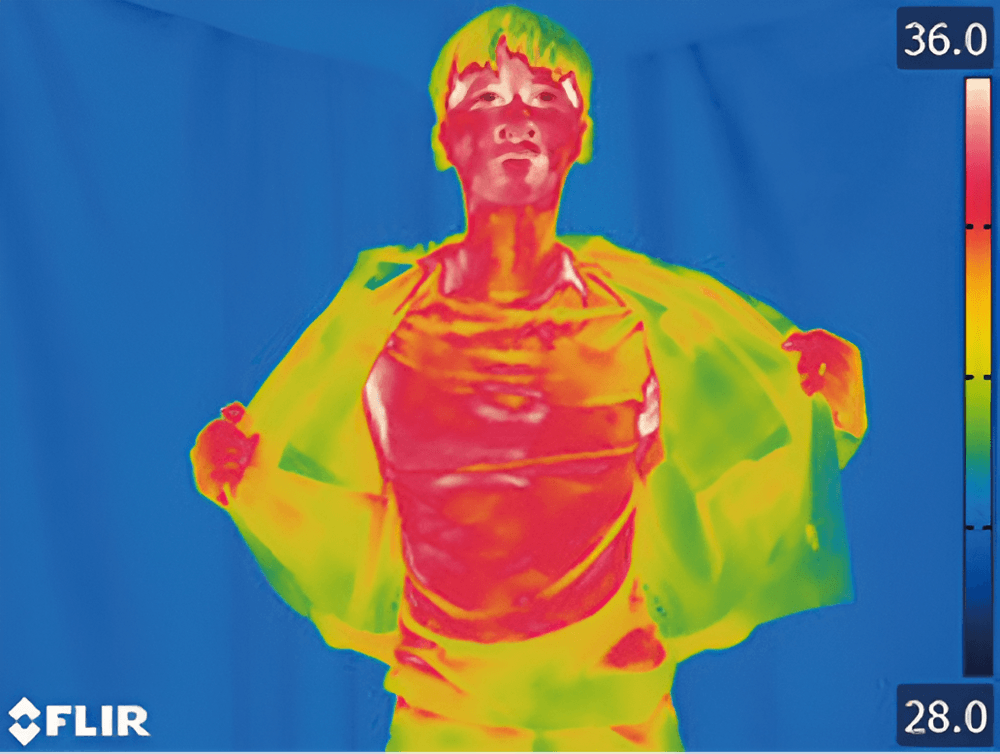
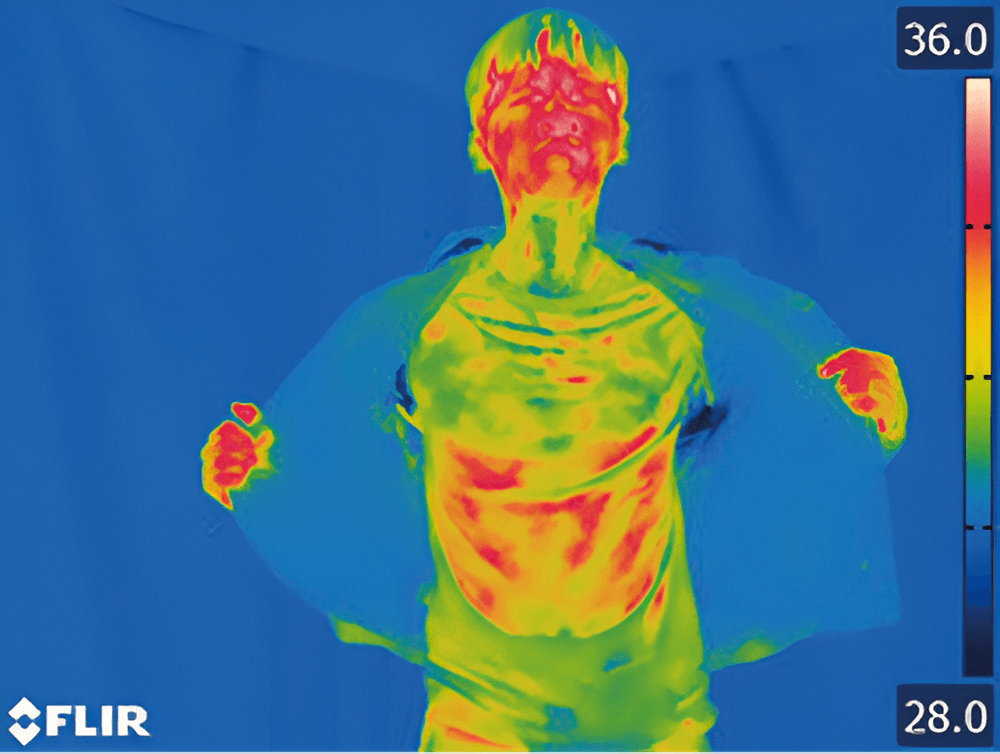
Fans off (left) and fans on (right), after ten minutes of activity at 86°F (30°C), 50% humidity. Red is warmer, blue is cooler.
The human body cools itself by evaporation. Sweat reaching the skin absorbs heat as it turns to vapor and carries that heat away. It's efficient and it's automatic.
The catch is that it only works if the sweat actually evaporates. Sweat that pools on skin or soaks into fabric removes almost no heat — the body loses the water and gets none of the cooling. So it sweats more. Fluid loss climbs, fatigue sets in, and core temperature keeps rising.
Two things stop evaporation: still air and saturated fabric. A work shirt on a windless day produces both.
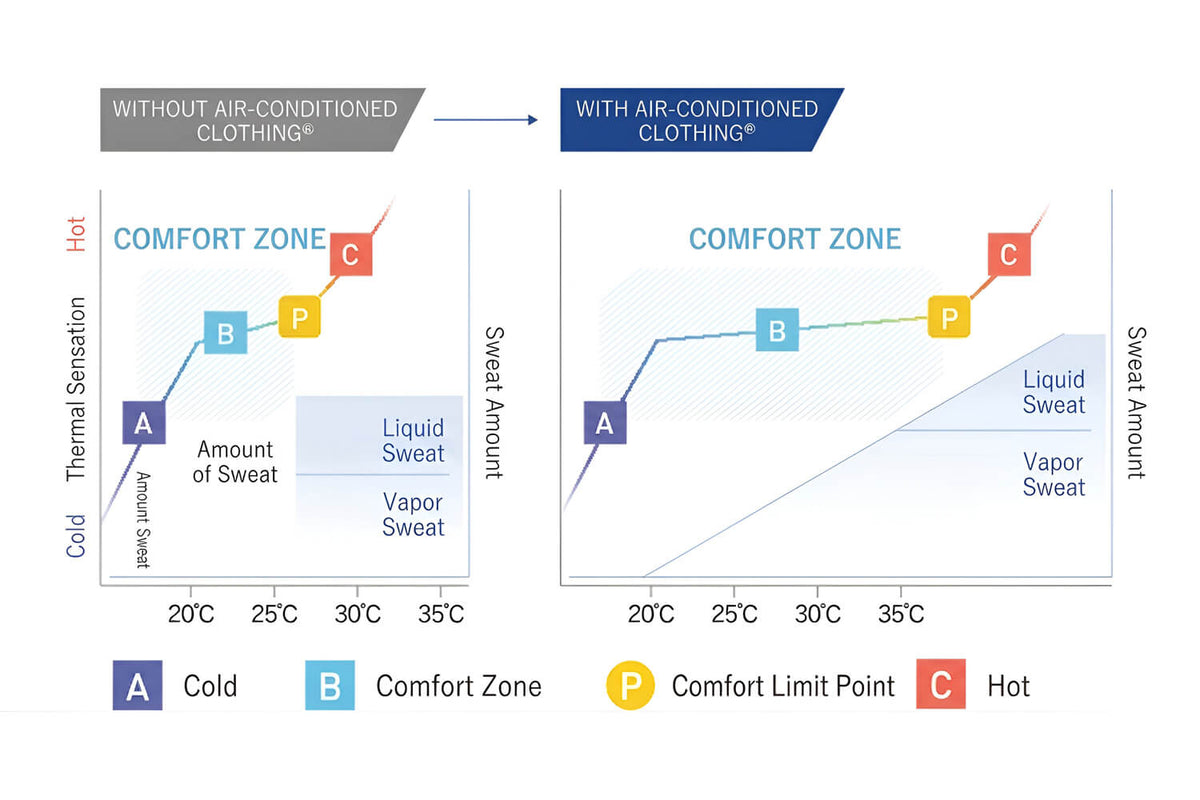
Without airflow (left), comfort ends around 77°F (25°C). With it (right), the comfort zone extends past 95°F (35°C) because sweat evaporates instead of pooling.
ZIPPKOOL doesn't add cold. It removes the obstacle — a continuous stream of air along the skin so sweat evaporates the moment it appears. The body's own mechanism, running at full capacity instead of half.
Two consequences worth stating:
- It cools the worker, not the space. No site cooling infrastructure required.
- Because sweat isn't wasted, the body produces only what it needs — less fluid loss, less fatigue.
02
Where it works best
Airflow cooling depends on ambient conditions, and being straight about that matters more than overclaiming.
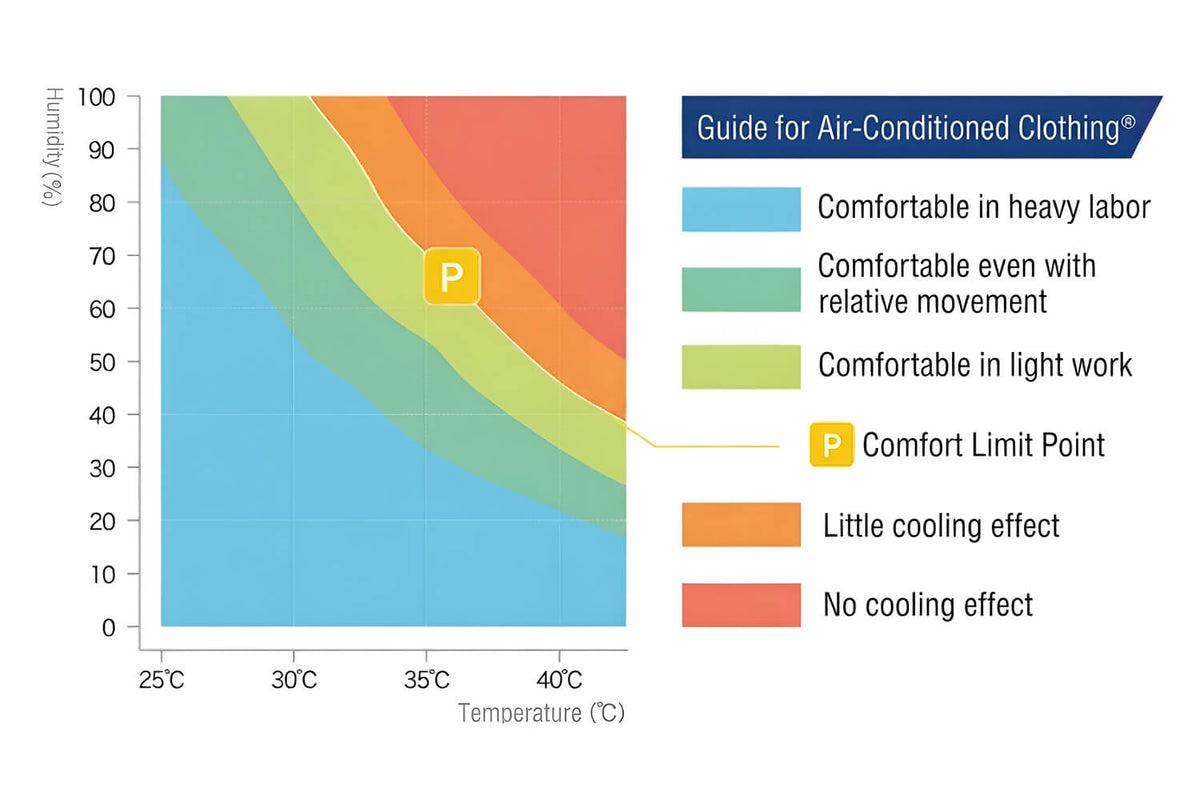
Cooling performance by temperature and humidity. Blue and green cover most job-site conditions; red marks where evaporative cooling stops working.
In sustained high humidity, phase-change cooling may outperform evaporative. In extreme dry heat above roughly body temperature, airflow alone does less. Neither replaces hydration, rest, shade, and acclimatization.
03
What it costs to run
Pennies a month to run
To charge one battery daily for a month. Cooling the worker instead of the space means no site infrastructure, no generator, no draw on the building.
Less waste, less fatigue
When sweat evaporates the moment it appears, the body produces only what it needs. Less fluid loss over a shift, and less of the fatigue that comes with it.
Comparison table
How it compares to what's already in the truck
Most crews already carry something for heat. The difference with fan-cooled gear is duration: it doesn't need refreezing, re-wetting, or a cooler on the job site.
| ZIPPKOOL fan-cooled | Ice / phase-change vest | Soak-in-water vest | Cooling towel | |
|---|---|---|---|---|
| How long it cools | Up to 20 hrs on one charge | Hours, not shifts | Hours, not shifts | Minutes |
| To reset it | Swap or recharge the battery | Refreeze the packs | Re-soak | Re-wet |
| Needs on site | Outlet to charge overnight | Freezer or ice cooler | Water source | Water |
| In high humidity | Reduced — evaporation slows | Unaffected | Reduced | Reduced |
| Stays dry | Yes | Yes | No | No |
| Added weight | Light, fans and battery only | Heavy when loaded | Moderate when wet | Negligible |
| ANSI hi-vis rated | Built in, Class 2 or Class 3 | Worn under or over hi-vis | Rarely | No |
| Harness compatible | Yes, D-ring passes through | Varies | Varies | — |
ZIPPKOOL isn't the right choice for every job. It's not flame-resistant and not intrinsically safe — for welding, hot work, or explosive atmospheres, use FR-rated gear and a non-powered cooling option. In sustained very high humidity, phase-change cooling may outperform evaporative. And fans must be switched off near rotating machinery.
Where it doesn't belong
ZIPPKOOL isn't right for every job
01
Not flame-resistant.
For welding, cutting, hot work, or anywhere FR clothing is required, use FR-rated gear and a non-powered cooling option.
02
Not intrinsically safe.
Not rated for explosive atmospheres — flammable gases, vapors, or combustible dust.
03
Fans off near rotating machinery.
Running fans inflate the garment. Near shafts, conveyors, augers, or power take-offs, switch them off and keep the garment zipped.
04
Not a replacement for the basics.
Cooling garments supplement — they don't replace — hydration, rest, shade, and acclimatization.
Cooling isn't the only requirement on a job site
A cooling garment that fails the hi-vis spec, or that a harness can't be worn over, doesn't get approved. ZIPPKOOL is built so nothing has to be traded away.
- ANSI/ISEA 107 Type R Class 2 and Class 3 — HVN-400U and HVN-510U
- Full-body harness compatible — rear opening passes the dorsal D-ring through
- ETL Certified battery — LI-PRO1U, tested by Intertek, an OSHA-recognized NRTL
- UN 38.3 and FCC — both battery packs
- Two-way radio loop
- Sizes S/M through 6XL/7XL — one platform fits the whole crew
- Common battery, fan, and cable across models — one set of spares, not three
Talk to us about your crew
Volume pricing, PO and net terms, and complete compliance documentation for your approval process.